The second infrastructure speed: why climate resilience now needs fast and slow adaptation
Abigail Mela ·
Climate adaptation has become remarkably good at describing the city we want to build. It has spent far less time asking how today's city continues to function until that future arrives.
Long-term transformation takes time
Across the world, cities are planting trees, expanding canopy cover, redesigning public spaces, replacing sealed surfaces, and investing in blue-green infrastructure. These measures are essential, and nothing about the growing urgency of extreme heat makes them less important. They all share one defining characteristic, however: they take time.
That is not a flaw. It is simply how infrastructure has always worked. Large-scale urban transformation requires planning, political approval, funding, procurement, and construction before its benefits are fully realised. A newly planted tree does not provide the shade of a mature canopy within a single summer, just as a redesigned public square cannot be delivered overnight.
Climate change is moving faster than infrastructure
The challenge is that climate change no longer follows the same timeline.
Europe is warming twice as fast as the global average, making it the fastest-warming continent, according to the European State of the Climate report from Copernicus and the World Meteorological Organization. Heatwaves are becoming more frequent, more intense, and longer lasting, while extreme heat is arriving earlier in the year. Following Europe's second major heatwave within two months in June 2026, climate adaptation moved even further into the political mainstream, with the European Commission signalling greater emphasis on helping societies adapt to unavoidable climate impacts alongside continued efforts to reduce emissions.
Cities amplify this exposure. Research by the European Commission's Joint Research Centre has shown that urban land-surface temperatures can be between 10 and 15°C higher than those of surrounding rural areas. While the exact difference varies by location, the underlying causes are well understood: dense construction, heat-absorbing materials, limited vegetation, and reduced air circulation allow cities to retain and generate heat. As urbanisation continues and climate change intensifies, the IPCC expects urban heat stress to become increasingly severe.
Places often fail before infrastructure does
Yet the first consequence of extreme heat is rarely physical damage. Public spaces seldom fail in the way bridges, roads or drainage systems fail. Squares remain open, streets continue to function and parks still exist.
What changes first is human behavior:
- People cross a square instead of sitting in it.
- Outdoor cafés empty earlier.
- Shopping streets lose visitors during the hottest hours.
- Office courtyards become unusable for lunch breaks or informal meetings.
A place can remain technically available while quietly losing the function it was designed to fulfill.
This distinction matters because climate adaptation is still primarily measured through physical indicators. Cities monitor air temperature, surface temperature, canopy cover, permeability, and stormwater capacity. These metrics remain essential, but they do not answer a fundamental question: does a place continue to work for people? Successful public spaces are not defined solely by their physical characteristics. They succeed because people continue to meet, work, rest, shop, learn and spend time there.
The adaptation gap is measured in time
Climate adaptation should therefore also be understood through the dimension of time.
- How much earlier do people leave a public square during a heatwave?
- How much shorter does lunch become on an office terrace?
- How many hours does a playground remain unusable?
- How does heat influence footfall, dwell time, or local commerce?
These are not secondary effects; they are leading indicators of whether climate conditions are beginning to undermine the social and economic purpose of a place. The widening distance between the climate people already experience and the city that long-term adaptation will eventually create can be described as an adaptation gap. It is not evidence that current strategies have failed, but the inevitable consequence of two legitimate but increasingly divergent timescales. Urban transformation unfolds over years. Extreme heat changes the way places are used within hours.
Climate resilience now requires two infrastructure speeds
This changes something more fundamental than the pace of individual projects, because it changes the way climate infrastructure itself needs to be understood.
Climate adaptation is entering an era of two infrastructure speeds.
One reshapes cities over decades, through trees, parks, water-sensitive urban design, and permanent transformation. The other strengthens climate resilience by preserving the functionality of places while that transformation is still unfolding. Together, they respond to different timelines, not different objectives. This is the emergence of a second infrastructure speed: the operational layer of climate resilience.
Rapid deployment can create lasting resilience
A second infrastructure speed does not replace long-term adaptation. It complements it, strengthening climate resilience from the moment a heat problem is recognized, and preserving the usability of places throughout that transition.
This is precisely the category AERISIO was created to serve. Rather than replacing permanent adaptation, AERISIO complements it, developing fast, modular cooling infrastructure that strengthens the climate resilience of cities and properties while ensuring that public spaces remain usable through increasingly hot summers.
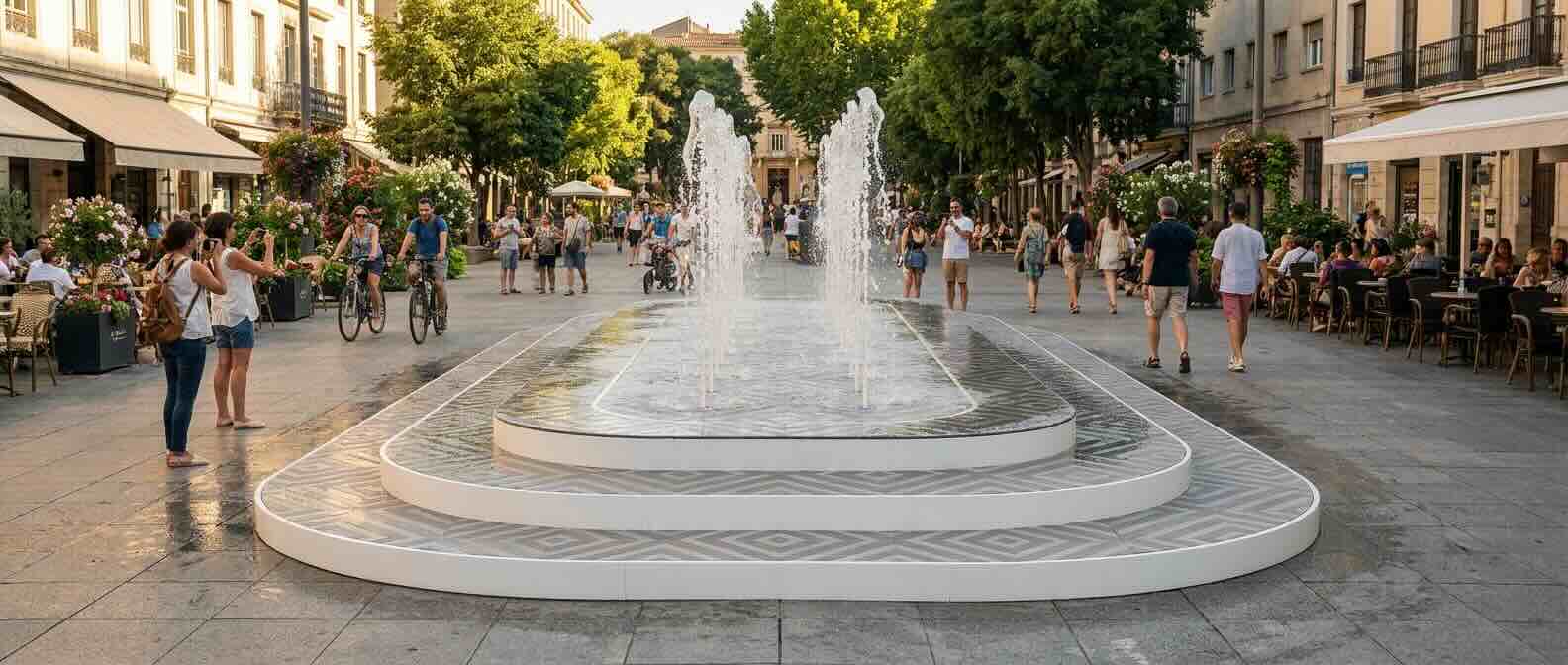
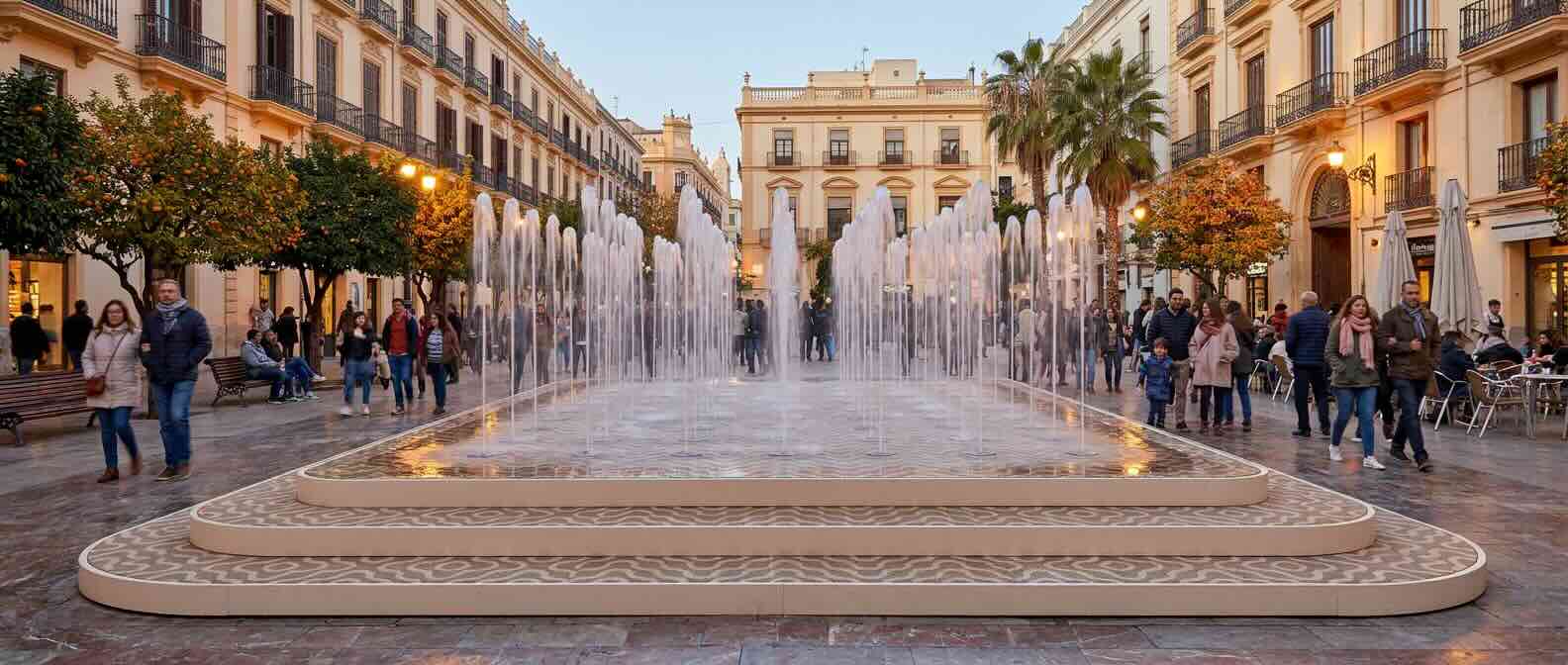
The AERISIO Oasis is manufactured in weeks with European partners, configured for each location, and installed above ground without excavation. It requires only three standard utility connections — water, drainage, and electricity — and is designed as long-term infrastructure, monitored continuously by the AERISIO WAVE edge intelligence for water quality, safety, and performance.
The city of 2040 must not come at the expense of today
The right climate infrastructure can deliver both fast deployment and long-term resilience, and this distinction is more than technical. It reflects an outdated assumption in how we think about climate adaptation: rapidly installed infrastructure is often perceived as temporary, while permanence is assumed to be synonymous with strategic value. That distinction is increasingly outdated. Infrastructure can be installed quickly, remain in place for a long time, and become an integral part of a city's long-term climate resilience.
Cities, hospitality groups, and property owners are increasingly being asked to manage two realities simultaneously. They must continue investing in the city of 2040 while ensuring that the city of today remains comfortable, economically vibrant, and socially active. These are not competing priorities but complementary responsibilities. The next era of climate adaptation will therefore not be defined solely by how well we redesign our cities. It will be defined by how intelligently we manage both infrastructure speeds at the same time.
Frequently asked questions
What is the "second infrastructure speed"? It is the faster, operational layer of climate resilience: infrastructure that can be deployed quickly to keep places usable through extreme heat, while slower, permanent adaptation — trees, redesign, green infrastructure — continues in parallel. The two speeds serve different timelines, not different goals.
What is the climate adaptation gap? The adaptation gap is the widening distance between the climate people already experience each summer and the cooler city that long-term adaptation will eventually deliver. It exists because urban transformation takes years while extreme heat changes how places are used within hours.
Why do public spaces "fail" in heat if nothing is physically damaged? Because the first failure is behavioral, not structural. A square, terrace or shopping street stays physically open but loses its function: people leave earlier, cafés empty, footfall drops. A place can be technically available while no longer doing what it was designed to do.
How much hotter are cities than surrounding areas? Research by the European Commission's Joint Research Centre has found urban land-surface temperatures can be 10–15°C higher than surrounding rural areas, driven by dense construction, heat-absorbing materials, limited vegetation and reduced air circulation.
Does fast cooling infrastructure mean temporary infrastructure? No. Speed of deployment and length of service are separate things. Infrastructure can be installed quickly and still be designed to remain in place for many years as part of long-term resilience. The AERISIO Oasis is installed in days but built as durable, long-term infrastructure.
About AERISIO
AERISIO is a property and climate technology company based in Finland. Its product, the AERISIO Oasis, is the first above-ground, productized cooling fountain: a modular, walkable, architectural water feature that installs on any hard surface in days, with no excavation. Design and engineering are automated with the AERISIO Configurator, and each Oasis is monitored continuously by the AERISIO WAVE edge intelligence for water safety and performance. AERISIO brings cooling placemaking to cities, real estate, and private residences.
Contact us to plan an Oasis for your city, portfolio, or residence.