---
title: What does a walkable fountain cost, and how long does it take? Eight European projects
description: European walkable and dry-deck fountains range from a few hundred thousand to several million euros, and take one to two years to build. A look at eight real projects — their cost, scope, and timelines — and why speed to impact now matters as much as price.
image: https://aerisio.com/hubfs/AERISIO%20walkable%20dry-deck%20fountain%20for%20cities%20and%20real%20estate.jpeg
---
[Available across Europe. Explore the Oasis. → ×](https://aerisio.com/oasis?hsLang=en-us)
[](https://aerisio.com/?hsLang=en-us)
- [For Real Estate](https://aerisio.com/real-estate?hsLang=en-us)
- [For Cities](https://aerisio.com/cities?hsLang=en-us)
- [For Residences](https://aerisio.com/residences?hsLang=en-us)
- [The Oasis](https://aerisio.com/oasis?hsLang=en-us)
- [Gallery](https://aerisio.com/gallery?hsLang=en-us)
- [Resources](https://aerisio.com/resources?hsLang=en-us)
- [About](https://aerisio.com/about?hsLang=en-us)
- [Contact](https://aerisio.com/contact?hsLang=en-us)
EN
- [EN](https://aerisio.com/resources/what-does-a-walkable-fountain-cost-and-how-long-does-it-take-eight-european-projects)
- [ES](https://aerisio.com/es/resources/cuanto-cuesta-una-fuente-transitable-y-cuanto-se-tarda-ocho-proyectos-europeos)
- [CA](https://aerisio.com/ca-es/resources/quant-costa-una-font-transitable-i-quant-triga-vuit-projectes-europeus)
- [PT](https://aerisio.com/pt/resources/quanto-custa-uma-fonte-transitavel-e-quanto-tempo-demora-oito-projetos-europeus)
- [FR](https://aerisio.com/fr/resources/combien-coute-une-fontaine-praticable-et-en-combien-de-temps-huit-projets-europeens)
- [IT](https://aerisio.com/it/resources/quanto-costa-una-fontana-calpestabile-e-quanto-tempo-richiede-otto-progetti-europei)
- [DE](https://aerisio.com/de/resources/was-kostet-ein-begehbarer-brunnen-und-wie-lange-dauert-es-acht-europaeische-projekte)
[Contact us](https://aerisio.com/contact?hsLang=en-us)
[← Resources](https://aerisio.com/resources)
# What does a walkable fountain cost, and how long does it take? Eight European projects
Abigail Mela · Aug 25, 2026
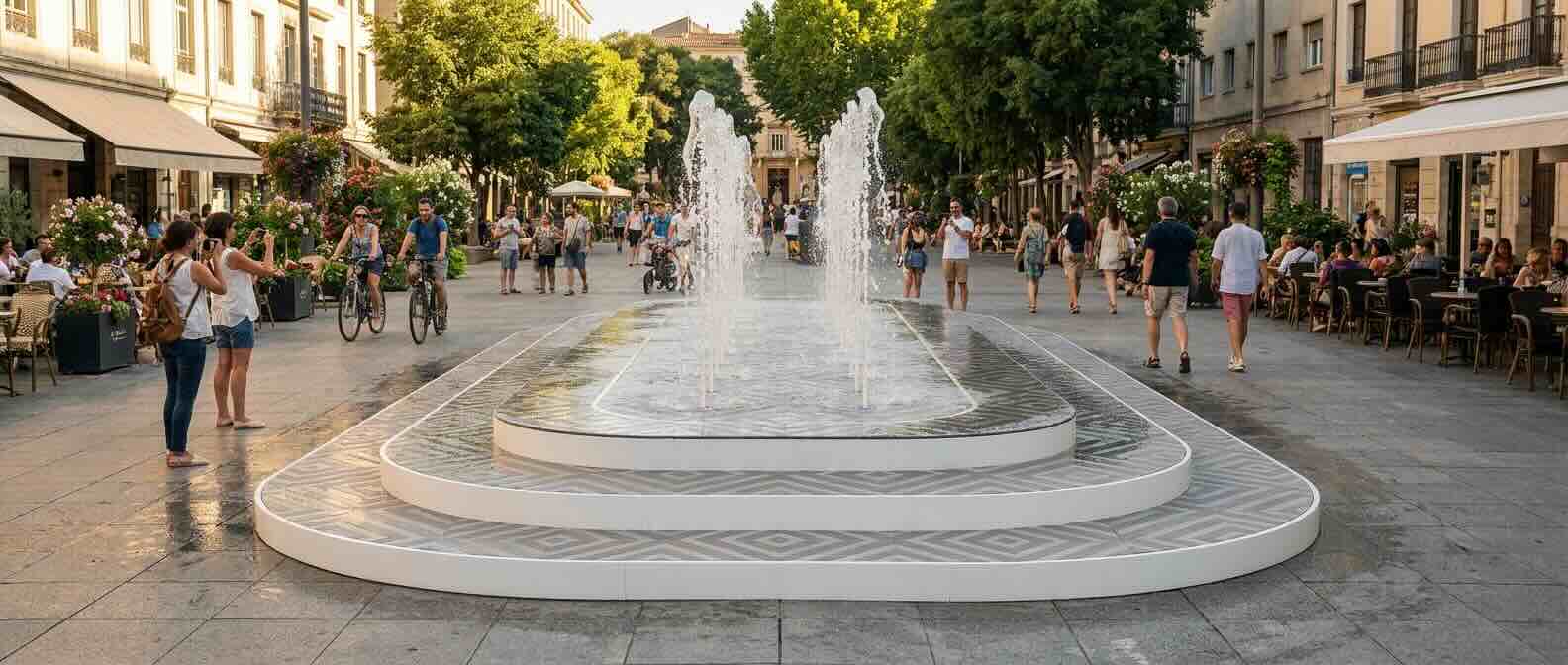
Walkable fountains — the ground-level water features that people walk through rather than around, often called dry-deck or dry-floor fountains — have become one of the most sought-after elements of contemporary public space. They cool, they draw crowds, and they give a plaza a sense of life. Across Europe, cities have built beautiful ones.
They have also, almost without exception, built them the same way. These are major construction projects, engineered and installed in place over the course of one to two years, usually as part of a much larger plaza or square redevelopment. Two questions come up for any decision-maker or budget-holder considering one — what does it cost, and how long does it take?
This article answers both, using eight real European projects and public, municipal sources. The costs range from a few hundred thousand euros into the millions, and the timelines run remarkably consistently to one or two years. Both matter, but as summers grow longer and hotter, speed to cooling placemaking is quickly becoming the more decisive factor.
## Eight European walkable and dry-deck fountain projects in terms of cost and time
In most of the fountain projects listed below, the fountain is one element of a wider urban redevelopment, so the headline budget often covers far more than the water feature itself. Where a figure is for the fountain alone — as in Toulouse and Stuttgart — it is noted. These are perhaps the most useful numbers for a true like-for-like understanding of fountain cost. Timelines, by contrast, are consistent across the board: one to two years, almost without exception.
| Location | Project | Reported budget (EUR) | Timeline | What the figure covers |
| --- | --- | --- | --- | --- |
| Toulouse, France | Dry-deck, 12 jets | 300,000 | 12+ months | The fountain system alone, within a ~€2M square redevelopment |
| Stuttgart, Germany | Dry-deck, 36 jets | 900,000 | 22+ months | The fountain, controls, and water treatment; wider square budget ~€11.7M |
| Rimini, Italy | Dry-deck, 12 jets | 1,500,000 | 24+ months | Station-square redevelopment including the fountain |
| Koprivnica, Croatia | Walk-through dry-deck | 2,370,000 | 18+ months | Full renewal of the city's central squares, including the fountain |
| Madrid, Spain | Splash pad, 72 jets | 2,600,000 | 6+ months (build) | Part of the Madrid Río project; design and engineering not included |
| Porto area, Portugal | Dry-deck, ~60 jets | 2,700,000 | 12+ months | The complete plaza renewal, including the fountain |
| Venice area, Italy | Four dry-deck fountains | 3,550,000 | 18+ months | Via Roma urban regeneration; streetscape, new public areas, four fountains |
| Vienna, Austria | Dry-deck and misting, 500 m² | 7,200,000 | 12+ months (build) | The whole climate redesign: the water feature plus 8,000 m² of greenery and 101 trees |
Sources, in order: Toulouse — [City of Toulouse contract notice](https://www.toulouse.fr); Stuttgart — [City of Stuttgart, "Fontänenfeld sprudelt auf dem Marktplatz"](https://www.stuttgart.de); Rimini — [Comune di Rimini](https://www.comune.rimini.it); Koprivnica — [Danica HR](https://danica.hr); Madrid — [City of Madrid, "La playa de Madrid"](https://www.madrid.es); Porto area — [O Regional, São João da Madeira](https://oregional.pt); Venice area — [Comune di Scorzè](https://www.comune.scorze.ve.it); Vienna — [City of Vienna, "Vom betonlastigen Bahnhofsvorplatz zur Grün-Oase"](https://www.wien.gv.at).
## What the numbers reveal about walkable fountain cost and time-to-impact
On cost, the honest reading is that it varies enormously and is hard to compare, precisely because the fountain feature is so often folded into a larger project. Vienna's €7.2 million was a complete climate redesign of a major transport hub — the 500m² water feature sat alongside thousands of square meters of new greenery and more than a hundred new trees. Porto's €2.7 million renewed an entire plaza. Where a figure isolates the fountain, as in Toulouse (€300,000) or Stuttgart (€900,000), the number comes down considerably, but it is still a serious capital commitment. Quoting a standard walkable fountain price from figures is not a straightforward or revealing comparison.
On time, the reading is unambiguous. Almost every project took between one to two years, and most took longer once the path from decision to design to approval to construction is considered. Even where the physical build was quicker — Madrid's splash pad was constructed in about six months — *that figure excludes the design and engineering done beforehand*. A walkable fountain, built the traditional way, is not something a city or a developer decides on in spring and enjoys that summer. It is a multi-year undertaking, tied to the rhythm of a construction project.
## Speed is becoming the primary factor as heat seasons lengthen and intensify
For decades, the design-and-construct timeline was simply the cost of elevating public or commercial space. Water in a public space has meant planning a project and waiting years until its opening ceremony. But the reason cities and property owners are turning to cooling features in the first place is changing. Water features are not only contributing to a beautiful square. They are responding to heat that arrives every summer, and that makes public spaces effectively unusable during the hours they are most needed.
Against that need, time is not a neutral cost. A plaza that will be cooled in a few years is a plaza that is unbearable this summer and the next two. An asset improved after eighteen months of construction is an asset whose outdoor space sits disrupted through several commercial seasons. When the problem is heat that is here now, the speed of the solution is part of its value — arguably the most important part.
This is the gap the [AERISIO Oasis](https://aerisio.com/?hsLang=en-us) is built to close. It belongs to the same walkable-fountain family as every project above, and it is designed to be just as architectural — shaped, surfaced, lit, and programmed to its setting. What differs is delivery. As the first above-ground, productized walkable fountain, an [Oasis](https://aerisio.com/oasis?hsLang=en-us) is configured and engineered automatically, installed on an existing hard surface in days, with no excavation and no construction. Its [water safety and performance](https://aerisio.com/resources/ensuring-safety-and-quality-in-walkable-fountains-the-aerisio-oasis?hsLang=en-us) are monitored continuously by the AERISIO WAVE edge intelligence.
An Oasis is not necessarily cheaper than a traditional build — at the larger end, a significant Oasis is a significant investment, as these projects are. What it changes is time. The difference between the projects in the table and an Oasis is not principally a difference of price. It is the difference between cooling a space two summers from now and cooling it now, when it's acutely needed.
## Frequently asked questions
**How long does it take to build a traditional walkable or dry-deck fountain?** Based on real European projects, typically one to two years of construction time, and event longer once decision, design, approval, and construction are all considered. Even where the physical build is faster, design and engineering happen beforehand and add to the total.
**How much does a walkable fountain cost?** It varies widely and is difficult to compare, because the fountain is usually part of a larger square or plaza redevelopment. Fountain-only figures in European projects have ranged from a few hundred thousand euros upward, while full-project budgets that include the fountain have reached several million and beyond. Any single price quoted from these should be read carefully for what it includes.
**Is the AERISIO Oasis cheaper than a traditional fountain?** Perhaps, but not necessarily. A premium Oasis carries an investment, much like the projects in this article. The Oasis's defining advantage is speed. It installs in days rather than being built over months or years, and without excavation or a construction site.
**Why does installation speed matter for a cooling feature?** Because the need it addresses — summer heat — is present now and returns every year. A feature that takes years to build leaves a space uncooled through those summers. A feature installed in days delivers its benefit in the same season, which is increasingly the point.
**What is a dry-deck fountain?** A dry-deck or dry-floor fountain is a walkable water feature whose jets rise from a level surface. People move among the water as the jets spray water. The [AERISIO Oasis](https://aerisio.com/oasis?hsLang=en-us) is a dry-deck fountain delivered as an above-ground product rather than a built-in-place construction.
---
## About AERISIO
[AERISIO](https://aerisio.com/?hsLang=en-us) is a property and climate technology company based in Finland. Its product, the AERISIO Oasis, is the first above-ground, productized cooling fountain: a modular, walkable, architectural water feature that installs on any hard surface in days, with no excavation. Design and engineering are automated with the AERISIO Configurator, and each Oasis is monitored continuously by the AERISIO WAVE edge intelligence for water safety and performance. AERISIO brings cooling placemaking to cities, real estate, and private residences.
[Contact us](https://aerisio.com/contact?hsLang=en-us) to plan an Oasis for your city, portfolio, or residence.
## More resources
[ Site-specific vs. modular climate infrastructure: how configurable cooling adapts to every place A public square, a hotel terrace and a shopping destination may all need better protection from extreme heat, but the infrastructure cannot ... Abigail Mela · Aug 26, 2026](https://aerisio.com/resources/site-specific-vs.-modular-climate-infrastructure-how-configurable-cooling-adapts-to-every-place?hsLang=en-us) [ Climate shelters and heat resilience: how everyday places become climate infrastructure Every summer brings another red-shaded map of Europe. Temperatures above 40°C, records broken, heat spreading across regions. What those ... Abigail Mela · Aug 26, 2026](https://aerisio.com/resources/climate-shelters-and-heat-resilience-how-everyday-places-become-climate-infrastructure?hsLang=en-us) [ Ornamental fountains, splash pads, and walkable fountains: a short guide to water in public spaces Water has drawn people together for as long as cities have existed. A fountain marks a meeting point; a jet of water invites a child to ... Abigail Mela · Aug 25, 2026](https://aerisio.com/resources/water-features-compared-ornamental-splash-pad-walkable-fountain?hsLang=en-us)
[](https://aerisio.com/?hsLang=en-us)
Fast, modular, smart urban cooling for
heat-resilient properties and cities.
- [For Real Estate](https://aerisio.com/real-estate?hsLang=en-us)
- [For Cities](https://aerisio.com/cities?hsLang=en-us)
- [For Residences](https://aerisio.com/residences?hsLang=en-us)
- [The Oasis](https://aerisio.com/oasis?hsLang=en-us)
- [Gallery](https://aerisio.com/gallery?hsLang=en-us)
- [Resources](https://aerisio.com/resources?hsLang=en-us)
- [About](https://aerisio.com/about?hsLang=en-us)
- [Contact](https://aerisio.com/contact?hsLang=en-us)
[hello@aerisio.com](mailto:hello@aerisio.com) · [LinkedIn](https://www.linkedin.com/company/aerisio)
AERISIO Ltd Rantakatu 8A, 92100 Raahe, Finland
© 2026 AERISIO Ltd Business ID FI36176024 Patents pending: FI 20267073, FI 20267110 [Privacy Policy](https://aerisio.com/privacy?hsLang=en-us)
AERISIO is a registered trademark of AERISIO Ltd in Finland (reg. no. 291323).
```json
{
"@context" : "https://schema.org",
"@type" : "Organization",
"email" : "hello@aerisio.com",
"logo" : "https://148934635.fs1.hubspotusercontent-eu1.net/hubfs/148934635/aerisio-black.png",
"name" : "AERISIO",
"sameAs" : [ "https://www.linkedin.com/company/aerisio" ],
"url" : "https://aerisio.com/"
}
```
```json
{
"@context" : "https://schema.org",
"@type" : "BlogPosting",
"author" : {
"@type" : "Person",
"name" : "Abigail Mela",
"url" : "https://aerisio.com/resources/author/abigail-mela"
},
"dateModified" : "2026-08-26T09:03:18.806Z",
"datePublished" : "2026-08-25T12:50:20.000Z",
"headline" : "What does a walkable fountain cost, and how long does it take? Eight European projects",
"image" : [ "https://aerisio.com/hubfs/AERISIO%20walkable%20dry-deck%20fountain%20for%20cities%20and%20real%20estate.jpeg" ],
"mainEntityOfPage" : {
"@id" : "https://aerisio.com/resources/what-does-a-walkable-fountain-cost-and-how-long-does-it-take-eight-european-projects",
"@type" : "WebPage"
},
"publisher" : {
"@type" : "Organization",
"logo" : {
"@type" : "ImageObject"
}
}
}
```
```json
{
"@context" : "https://schema.org",
"@type" : "Article",
"author" : {
"@type" : "Person",
"name" : "Abigail Mela"
},
"dateModified" : "2026-08-26",
"datePublished" : "2026-08-25",
"description" : "European walkable and dry-deck fountains range from a few hundred thousand to several million euros, and take one to two years to build. A look at eight real projects — their cost, scope, and timelines — and why speed to impact now matters as much as price.",
"headline" : "What does a walkable fountain cost, and how long does it take? Eight European projects",
"image" : "https://148934635.fs1.hubspotusercontent-eu1.net/hubfs/148934635/AERISIO%20walkable%20dry-deck%20fountain%20for%20cities%20and%20real%20estate.jpeg",
"mainEntityOfPage" : "https://aerisio.com/resources/what-does-a-walkable-fountain-cost-and-how-long-does-it-take-eight-european-projects",
"publisher" : {
"@type" : "Organization",
"logo" : {
"@type" : "ImageObject",
"url" : "https://148934635.fs1.hubspotusercontent-eu1.net/hubfs/148934635/aerisio-black.png"
},
"name" : "AERISIO"
}
}
```
```json
{
"@context" : "https://schema.org",
"@type" : "BreadcrumbList",
"itemListElement" : [ {
"@type" : "ListItem",
"item" : "https://aerisio.com/resources",
"name" : "Resources",
"position" : 1
}, {
"@type" : "ListItem",
"item" : "https://aerisio.com/resources/what-does-a-walkable-fountain-cost-and-how-long-does-it-take-eight-european-projects",
"name" : "What does a walkable fountain cost, and how long does it take? Eight European projects",
"position" : 2
} ]
}
```
```json
{
"@context" : "https://schema.org",
"@type" : "FAQPage",
"mainEntity" : [ {
"@type" : "Question",
"acceptedAnswer" : {
"@type" : "Answer",
"text" : "Based on real European projects, typically one to two years of construction time, and event longer once decision, design, approval, and construction are all considered. Even where the physical build is faster, design and engineering happen beforehand and add to the total."
},
"name" : "How long does it take to build a traditional walkable or dry-deck fountain?"
}, {
"@type" : "Question",
"acceptedAnswer" : {
"@type" : "Answer",
"text" : "It varies widely and is difficult to compare, because the fountain is usually part of a larger square or plaza redevelopment. Fountain-only figures in European projects have ranged from a few hundred thousand euros upward, while full-project budgets that include the fountain have reached several million and beyond. Any single price quoted from these should be read carefully for what it includes."
},
"name" : "How much does a walkable fountain cost?"
}, {
"@type" : "Question",
"acceptedAnswer" : {
"@type" : "Answer",
"text" : "Perhaps, but not necessarily. A premium Oasis carries an investment, much like the projects in this article. The Oasis's defining advantage is speed. It installs in days rather than being built over months or years, and without excavation or a construction site."
},
"name" : "Is the AERISIO Oasis cheaper than a traditional fountain?"
}, {
"@type" : "Question",
"acceptedAnswer" : {
"@type" : "Answer",
"text" : "Because the need it addresses — summer heat — is present now and returns every year. A feature that takes years to build leaves a space uncooled through those summers. A feature installed in days delivers its benefit in the same season, which is increasingly the point."
},
"name" : "Why does installation speed matter for a cooling feature?"
}, {
"@type" : "Question",
"acceptedAnswer" : {
"@type" : "Answer",
"text" : "A dry-deck or dry-floor fountain is a walkable water feature whose jets rise from a level surface. People move among the water as the jets spray water. The AERISIO Oasis is a dry-deck fountain delivered as an above-ground product rather than a built-in-place construction."
},
"name" : "What is a dry-deck fountain?"
} ]
}
```