Why urban heat resilience needs the whole built environment at the table
Abigail Mela ·
AERISIO joins the Urban Land Institute
Heat resilience is usually discussed in terms of what cities must protect against, from rising temperatures and health risks to strain on infrastructure. That work is essential. But there is a second side to the conversation that receives far less attention — what cities can create, and the possibilities therein.
Cooling placemaking starts from a simple observation. People choose where to spend time outdoors, and in hotter summers, thermal comfort increasingly determines that choice. A plaza with shade and water draws people in on a hot afternoon. One without them empties out. The difference shows up in footfall, in commercial activity, and in whether a public space fulfills its purpose.
Seen this way, cooling is not only a defensive measure. It is a way to create places people want to use, and that keep working as summers grow hotter. It connects climate adaptation with the everyday goals of the built environment — vibrant public space, successful real estate assets, and communities that thrive.
And at its best, cooling placemaking is more than useful. It can be a stunning place in its own right, somewhere children play, neighbors meet, and visitors remember. The most resilient public spaces are often the ones people love most.
Bringing these sides together, protection, placemaking, and experience, takes more than any single discipline. It needs the whole built environment at the table.
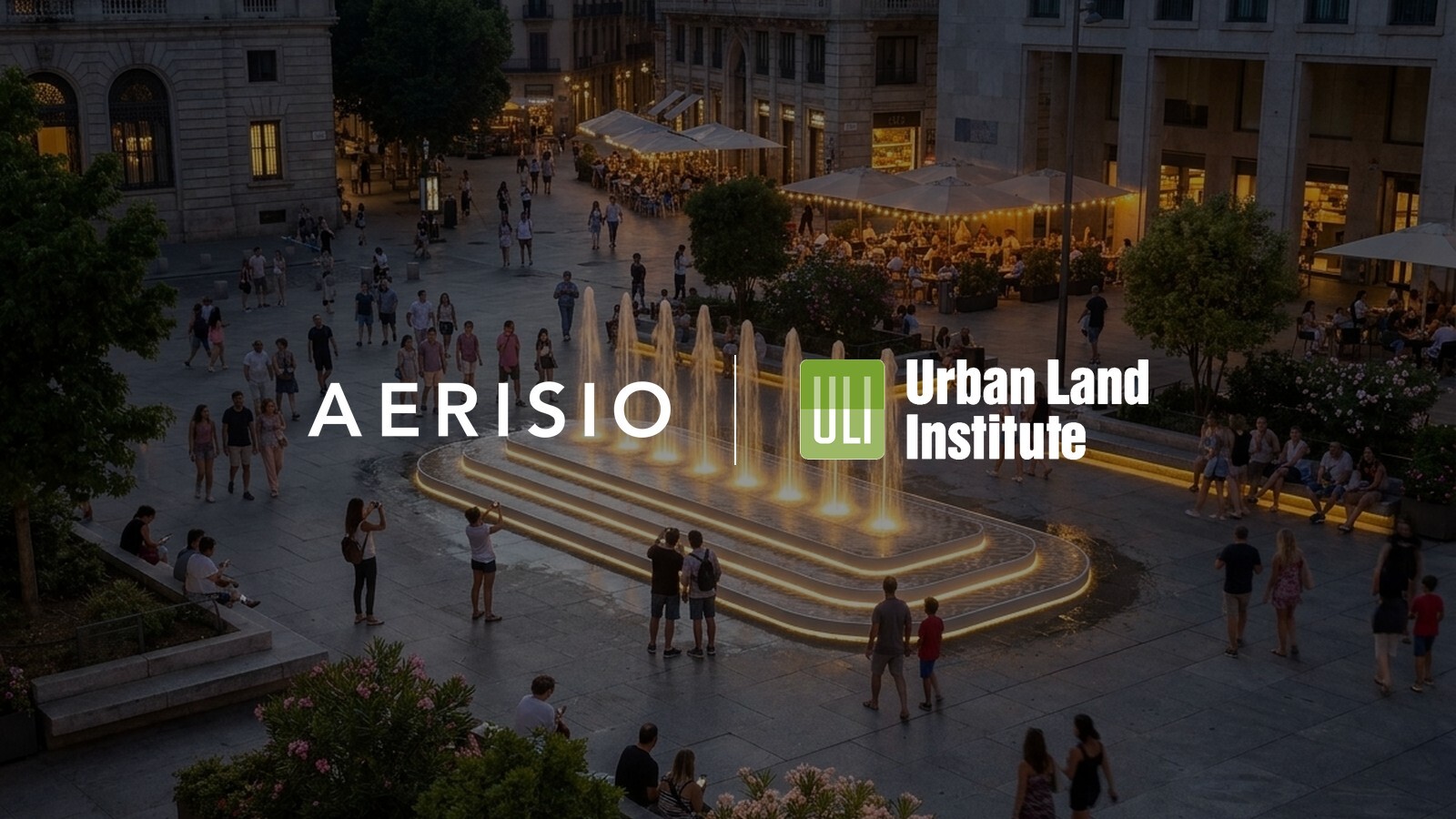
That is why AERISIO has joined the Urban Land Institute, as a member of both ULI Spain and ULI Europe.
Heat is a built environment question
When outdoor space becomes uncomfortable, the effects reach far beyond comfort. Footfall shifts. Dwell time shortens. Commercial activity moves indoors or to early morning and late evening hours. Public spaces designed as places to gather instead become places to pass through.
These effects are felt by city leaders responsible for public space, by asset managers responsible for tenant performance, by developers planning communities that will stand for decades, and by investors pricing long-term risk. Each sees one part of the picture. None can address it alone.
Responding well to heat requires decisions that cross disciplines. Urban planners shape where shade and water can go. Architects and landscape designers shape how spaces feel. Engineers shape what can be built, and how fast. Owners and investors shape what gets funded. Municipalities shape what gets permitted. When these conversations happen separately, adaptation is slow. When they happen together, it can move at the pace the climate now demands.
ULI convenes those who shape cities
For nearly a century, the Urban Land Institute has been bringing together leaders from across the real estate and land use community, including developers, investors, asset managers, architects, planners, public officials, and advisors. Its strength is not a single point of view. It is the quality of the conversation between people who rarely sit at the same table, as well as its long tradition of turning that conversation into shared knowledge and better practice.
ULI has also made climate resilience a central part of that work, treating it not as a niche topic but as a core question for how cities and real estate create lasting value. That is the conversation we at AERISIO are here to be a part of.
“Heat is a design and investment question, not only a climate one,” says Martti Mela, CEO and Co-Founder of AERISIO. “The decisions that will make our cities livable in hotter summers are being made today, in planning meetings, investment committees, and city councils. ULI brings together the people who make those decisions. We joined to learn from their experience, to contribute what we are learning about keeping outdoor space usable and inviting on the hottest days, and to help move the conversation from understanding the problem to acting on it.”
Three questions the industry must answer
We join ULI as a young company with a clear focus, and with a great deal still to learn from members who have shaped cities and portfolios for decades. We see three areas where the conversation matters most.
Public space as infrastructure. Plazas, streets, parks, and shared courtyards are often treated as finishing touches, designed once and left to age. In a hotter climate, they become infrastructure, places that either keep a city functioning in summer or fail to. We want to understand how cities and owners are rethinking the role of outdoor space, and how it can be planned, funded, and maintained with the same seriousness as buildings.
The speed of adaptation. Many of the most effective responses to heat take years. Trees take years to grow. Traditional public works take years to plan, permit, and build. Both are essential. But cities and owners also need options that can be implemented within a single planning cycle, so that the places people use today become more comfortable while long-term solutions mature. We are interested in how the industry balances long-term and near-term action, and how procurement, permitting, and investment models can support both.
Measuring the value of comfort. Thermal comfort is still rarely expressed in the language of investment. Yet its effects are visible in footfall, dwell time, tenant performance, and the attractiveness of a place over time. We believe the industry would benefit from shared ways to measure these effects, so that climate adaptation can be evaluated not only as a cost but as a contribution to asset value and public life.
Europe is looking to Spain
Our membership spans both levels of ULI. Urko Cantalapiedra, our Commercial Director for Spain, joins the ULI Spain community, while Martti Mela and Abigail Mela, AERISIO’s CMO and Co-Founder, take part in ULI Europe.
Spain matters especially to us. Its cities have lived with intense summer heat for centuries, and have built a deep culture of shade, water, and outdoor life around it. As summers grow hotter still, that experience is becoming valuable far beyond Spain’s borders, and cities across Europe are increasingly looking to Spain for ideas and answers. It is also where much of our own work is focused. We want to listen closely to the priorities of the people who build and manage Spain’s cities, and to test our thinking against theirs.
At the European level, we see the same questions emerging in cities that were not historically associated with summer heat. Sharing experience between the South and the North of Europe, between cities that have long lived with heat and those now meeting it, is one of the most valuable things a network like ULI can do.
Cooling cities takes every tool
Urban heat does not have one solution. Trees and green infrastructure provide shade and biodiversity that grow more valuable over time. Shade structures and misting offer fast, low-cost relief. Water, in its many forms, has cooled public space for centuries. Thoughtful urban design ties these together.
Our contribution is one part of that toolkit, and one that is as much about experience as it is about relief. What matters most is that the people responsible for cities and real estate have the knowledge, the evidence, and the relationships to choose and combine the right tools for each place. That is the work ULI makes possible, and the work we are proud to join.
We look forward to the conversations ahead, in Spain and across Europe.
AERISIO is a Nordic property and climate technology company delivering urban cooling placemaking for heat-resilient cities and real estate. Its mission is to revitalize urban spaces so cities thrive.